 Guides
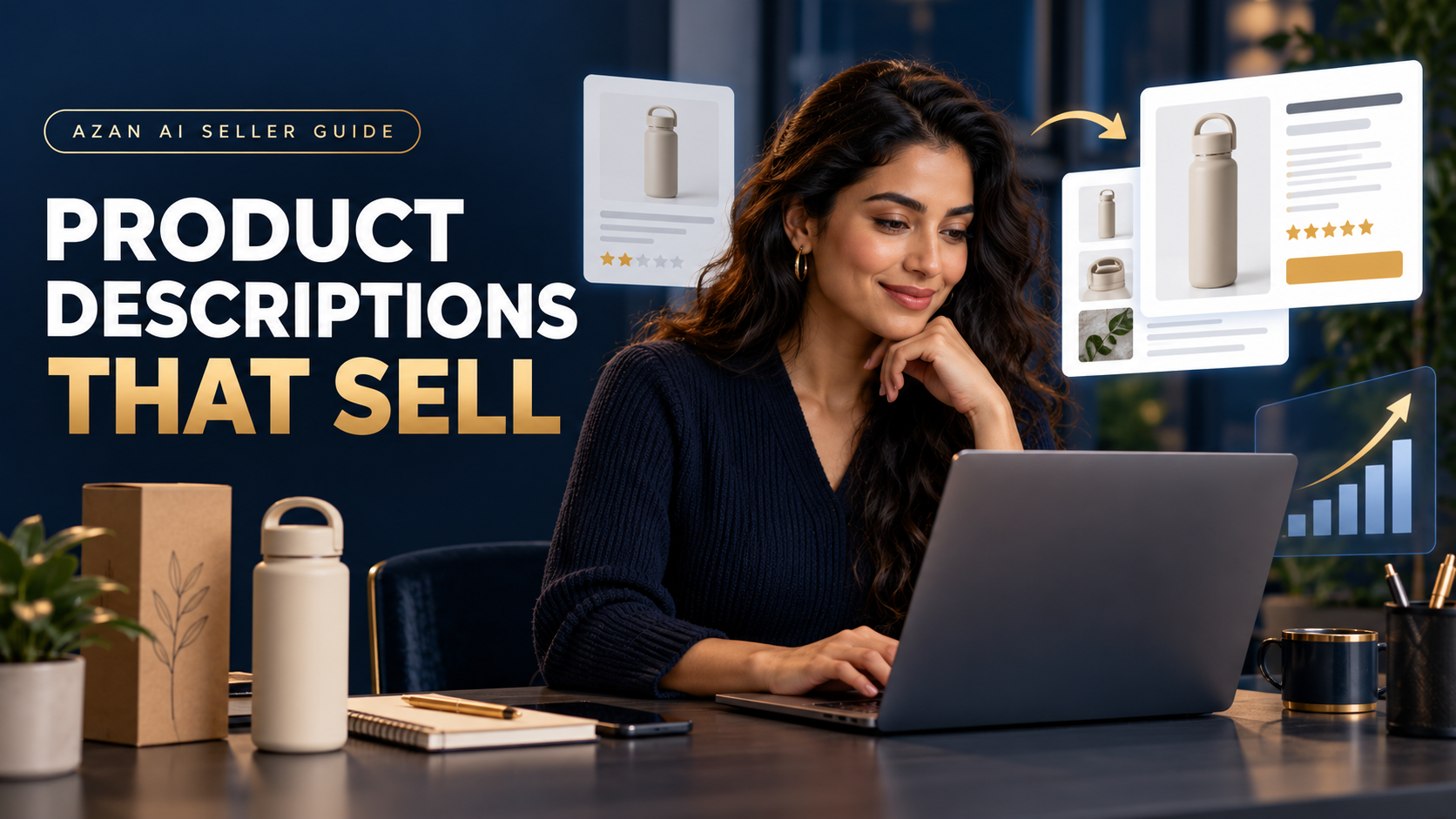
How to Write Product Descriptions That Rank and Convert in 2026
By Muhammad Nadeem · Blog #26
Updated
📖 9 min read · 1,954 words
Maya had a product people genuinely loved.
Her reusable water bottle looked elegant, kept drinks cold and received positive feedback from everyone who tried it. She photographed it carefully, uploaded it to her online store and waited for orders.
Visitors arrived—but most left without buying.
Her product description said:
High-quality stainless-steel water bottle. Durable, stylish and ideal for daily use.
Nothing in that sentence was technically wrong.
But it did not answer the questions shoppers were silently asking:
- How long will it keep my drink cold?
- Will it fit inside my car’s cup holder?
- Is it likely to leak inside my bag?
- Is it easy to clean?
- Why should I choose it over similar bottles?
Maya did not have a product problem.
She had a communication problem.
That distinction matters because a product description has two important jobs:
- Help the right shopper discover the product.
- Give that shopper enough confidence to buy it.
This guide explains how to do both.
What is product description SEO?
Product description SEO is the practice of writing accurate and useful product-page content that helps customers, search engines and marketplace search systems understand what you sell.
It is not the practice of repeating the same keyword until the description becomes difficult to read.
An effective SEO product description connects three elements:
| Search intent | Product information | Customer benefit |
|---|---|---|
| What the shopper searches | What the product is | Why it matters |
| Leak-resistant water bottle | Secure screw-top lid | Carry it with greater confidence |
| Insulated bottle for work | Double-wall insulation | Keep drinks cold during the workday |
| Reusable travel bottle | Durable refillable design | Reduce the use of disposable bottles |
The strongest ecommerce copy is written for people first while making the product easy for search systems to understand.
Why generic product descriptions struggle
A generic product description usually makes one or more of these mistakes:
- It relies on empty words such as “amazing,” “premium” or “best.”
- It lists features without explaining their practical value.
- It copies a manufacturer’s description.
- It ignores questions that may prevent a purchase.
- It targets broad keywords with unclear buying intent.
- It sounds almost identical to competing listings.
- It makes claims that the seller cannot verify.
Consider this example:
Premium-quality backpack with multiple compartments and a modern design.
Now compare it with this version:
Organize your daily commute with a lightweight laptop backpack featuring a padded 15-inch device compartment, two quick-access pockets and adjustable shoulder straps for comfortable everyday travel.
The second version tells the shopper:
- What the product is
- Who may find it useful
- When it can be used
- What fits inside it
- How it can improve the customer’s routine
That is the difference between describing an object and helping someone make a buying decision.
The five-part formula for better product descriptions
1. Begin with the shopper’s main outcome
Do not always begin with the material, model number or manufacturing method.
Begin with what the shopper wants to achieve.
Weak opening:
This organizer is made from durable polyester.
Stronger opening:
Keep cables, chargers and small travel accessories organized in one compact case.
The material can still be mentioned later. The opening should communicate immediate relevance.
Quick test
If the product name disappeared, would the opening sentence still reveal who the item helps and why it is useful?
If not, make the benefit clearer.
2. Turn important features into benefits
Features explain what a product has.
Benefits explain what those features do for the customer.
| Feature | Customer benefit |
|---|---|
| Adjustable strap | Change the fit for greater comfort |
| Water-resistant exterior | Protect everyday belongings from light splashes |
| Removable divider | Reconfigure the interior for different items |
| Foldable construction | Store it more easily when it is not needed |
| Multiple pockets | Keep smaller belongings easier to find |
Avoid making claims that you cannot prove.
For example, do not describe something as waterproof if it has only been tested against light splashes. Do not call a product “medical grade,” “eco-friendly” or “clinically proven” without appropriate evidence.
Trust is more valuable than exaggerated copy.
3. Use one primary keyword naturally
Choose a primary search phrase that accurately describes the product and reflects what a potential customer may search.
For example:
Primary keyword: insulated stainless-steel water bottle
Possible supporting phrases include:
- Reusable water bottle
- Leak-resistant bottle
- Water bottle for work
- Insulated travel bottle
- Double-wall bottle
Use the primary phrase naturally in important locations, such as:
- Product title
- Opening paragraph
- One relevant heading
- Image alt text
- Page title
- Meta description
Do not force every keyword variation into the page.
Keyword stuffing makes a product description harder to read and does not create a better shopping experience.
A keyword should clarify the product—not interrupt the customer.
4. Remove purchase anxiety
Customers often hesitate because important information is missing.
Depending on the product, answer questions about:
- Size and dimensions
- Materials
- Capacity
- Compatibility
- Colour or design variations
- Care instructions
- Package contents
- Intended use
- Delivery format
- Important limitations
A phone case listing should identify the compatible phone models.
A printable product should clearly state that it is a digital download and that no physical item will be shipped.
A clothing description should include useful sizing information.
A replacement component should explain which devices or models it supports.
Every unanswered question can become a reason to leave without purchasing.
5. Make the description easy to scan
Many customers do not read a product page from beginning to end. They scan it for the information that matters to them.
Use:
- Short paragraphs
- Clear subheadings
- Three to five meaningful bullet points
- Simple language
- Specific information
- Comfortable spacing
Avoid:
- Long walls of text
- Too many emojis
- Entire sentences written in capital letters
- Repeating the product title
- Ten bullets communicating nearly the same benefit
- Technical language that the customer may not understand
Clear formatting helps customers find useful information without unnecessary effort.
Before and after: Maya’s product description
Before
High-quality stainless-steel water bottle. Durable, stylish and ideal for daily use.
After
Stay refreshed throughout work, travel and everyday errands with this insulated stainless-steel water bottle. Its double-wall construction helps maintain your drink’s temperature, while the secure screw-top lid makes it practical for commuting and daily carrying.
Why you’ll love it:
- Double-wall insulated construction
- Secure lid designed for everyday carrying
- Slim shape suitable for many standard cup holders
- Reusable stainless-steel body
- Easy-to-clean everyday design
Ideal for: office desks, commuting, workouts and day trips.
Check the listed dimensions and capacity before ordering to ensure the bottle suits your needs.
The revised version is not more persuasive because it uses louder language.
It is more persuasive because it provides more useful information.
Maya’s product did not change. Its value simply became easier to understand.
Write for customers at different decision stages
Not every visitor arrives with the same level of buying intent.
Some shoppers are still exploring their options. Others are comparing similar products. Some are almost ready to purchase but need one final detail.
A useful description should support all three.
The exploring customer wants to know:
- What is this product?
- Who is it for?
- What problem does it solve?
The comparing customer wants to know:
- What makes it different?
- Which features matter?
- Is it suitable for my situation?
The nearly-ready customer wants to know:
- Will it fit?
- What exactly is included?
- Are there any limitations?
- How do I care for it?
- What happens after I order?
The more clearly you answer these questions, the less work the customer must do before making a decision.
Use AI without losing accuracy or personality
AI can help sellers:
- Restructure awkward sentences
- Turn features into customer benefits
- Improve clarity
- Remove unnecessary repetition
- Create a more organized first draft
- Adapt copy for different marketplaces
- Prepare content for translation
However, AI should assist the seller—not replace the seller’s responsibility.
Always verify:
- Dimensions and capacity
- Materials
- Compatibility
- Included accessories
- Performance claims
- Safety information
- Care instructions
- Delivery information
- Marketplace requirements
Never publish an invented feature simply because it sounds convincing.
Improve your product description with Azan AI
Use the Azan AI Marketplace Description Rewriter to transform an ordinary draft into clearer, more organized and customer-focused marketplace copy.
https://azanai.cloud/tools/marketplace-description-rewriter
Provide accurate product information, review the generated copy and adjust it to match your brand’s voice.
If you sell to customers in multiple languages, use the Azan AI Product Translation Tool to prepare your product listing for wider audiences.
https://azanai.cloud/tools/product-translation
Always confirm that the translated version preserves the correct specifications, measurements, meaning and product limitations.
A reusable product-description template
Copy this structure whenever you create a new product listing.
Opening benefit
Help [target customer] achieve [desired outcome] with this [primary product keyword].
Short explanation
Designed for [main use], it combines [important feature] with [important feature] to make [customer task] easier.
Key benefits
- [Feature]: [Practical customer benefit]
- [Feature]: [Practical customer benefit]
- [Feature]: [Practical customer benefit]
- [Feature]: [Practical customer benefit]
Essential details
- Material:
- Size:
- Capacity:
- Compatibility:
- Colour:
- Package includes:
- Care instructions:
Best suited for
Ideal for [customer type, situation or use case].
Honest clarification
Mention any important limitation, requirement or variation the customer should understand before purchasing.
Final product-description checklist
Before publishing, confirm that:
- The opening explains the product’s main benefit.
- The primary keyword appears naturally.
- Important features are connected to practical benefits.
- Dimensions, materials and compatibility are accurate.
- The description answers likely buying questions.
- The content is comfortable to read on a mobile screen.
- Unsupported or exaggerated claims have been removed.
- The description is different from competing listings.
- The language sounds natural.
- Package contents are clearly explained.
- Any important limitations are disclosed.
- Every AI-generated statement has been verified.
A product description cannot rescue a poor product or create demand where none exists.
But when the product is right, clear copy can help the right customer recognize its value.
Maya’s water bottle did not suddenly become better.
Its benefits simply became easier to understand.
Sometimes the fastest way to improve a listing is not to change the product—it is to explain the product better.
Frequently asked questions
How long should a product description be?
There is no perfect universal length. Use enough words to explain the main benefits, specifications, use cases and limitations without repeating yourself.
A simple item may need only a few focused paragraphs, while a technical product may require more detail.
Should every product have a unique description?
Yes. Unique product descriptions allow you to address the exact features, audience and search intent of each item.
Copying the same description across multiple listings reduces usefulness and may confuse customers.
How many keywords should I use?
Focus on one accurate primary keyword and a small number of natural supporting terms.
Relevance and readability matter more than repeating a long list of keywords.
Can AI write the entire product listing?
AI can create a useful draft, improve structure and suggest clearer wording. However, the seller remains responsible for accuracy.
Always verify specifications, product claims and marketplace requirements before publishing.
Can I translate one description for multiple countries?
Yes, but effective localization may involve more than literal translation.
Review measurements, terminology, customer expectations, cultural context and product claims for every target market.
Should I use the same description on Amazon, Etsy and Shopify?
The main product facts should remain consistent, but the presentation may need adjustment.
Each platform has different customers, formatting options and listing requirements. Adapt the structure without changing the truth of the product.
Ready to improve your next listing?
Turn an ordinary product draft into clearer, more persuasive marketplace copy with Azan AI.
https://azanai.cloud/tools/marketplace-description-rewriter
Write accurately. Explain benefits clearly. Help the right customer buy with confidence.
Reference: Blog #26 — quote this number if you contact us about this article