 Marketplace SEO
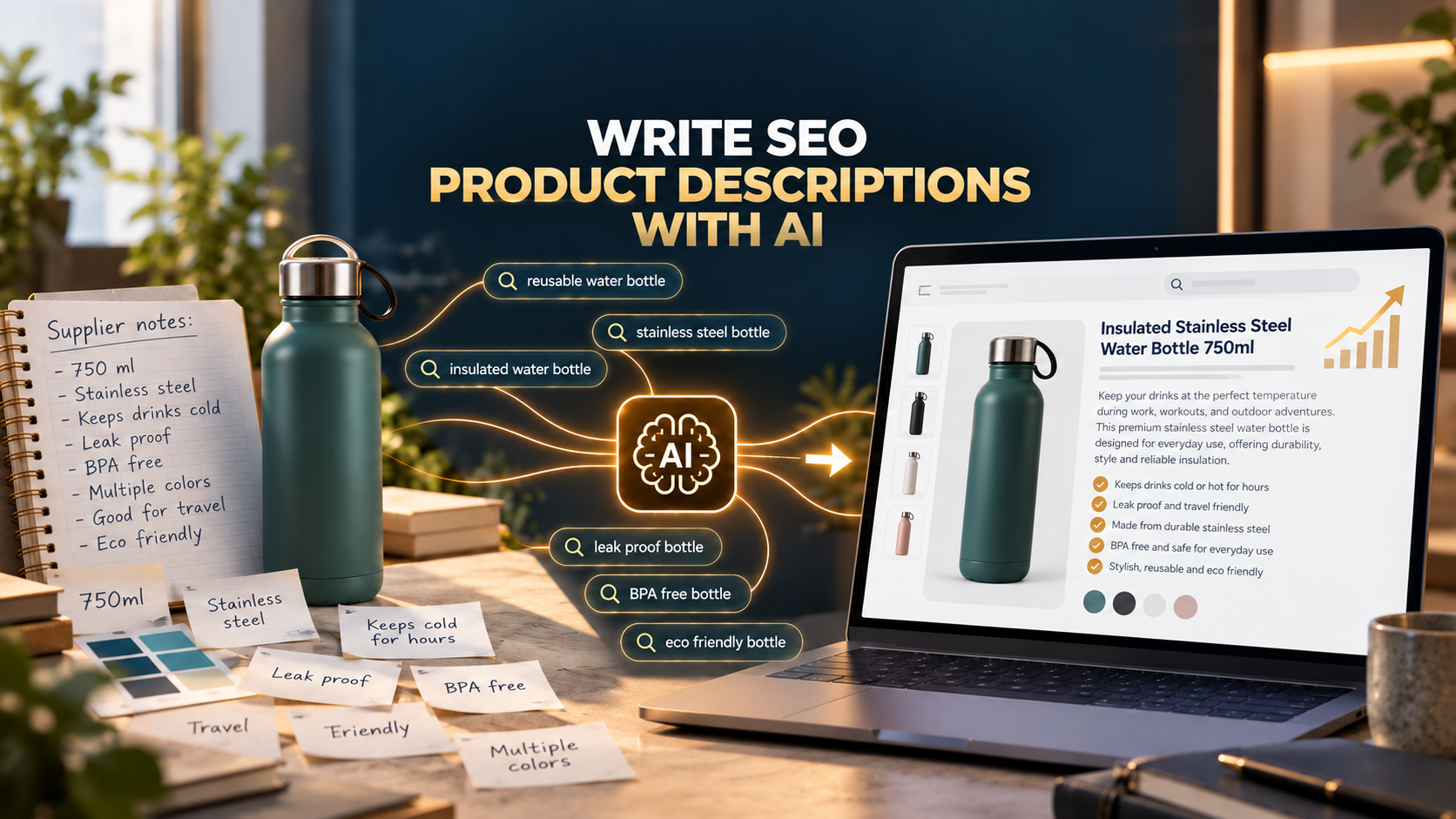
How to Write SEO Product Descriptions with AI
By Muhammad Nadeem · Blog #28
Updated
📖 9 min read · 1,973 words
Writing a product description sounds simple until you need to create clear, persuasive, keyword-focused copy for dozens—or hundreds—of products.
For Amazon, Noon, Shopify, and Etsy sellers, a good description must explain the product accurately, match buyer search intent, remain easy to read, and follow marketplace rules. It also needs to persuade shoppers without exaggerating what the product can do.
Learning how to write SEO product descriptions with AI can make this process faster. The key is to give AI verified information, useful keywords, and a clear structure instead of simply asking it to “write something attractive.”
This guide shows you a practical workflow for creating product descriptions that support search visibility and conversions without sacrificing accuracy or credibility.
What Is an SEO Product Description?
An SEO product description is copy written to help both shoppers and search systems understand a product.
It should clearly communicate:
- What the product is
- Who it is designed for
- Which problem it solves
- Its most important features and benefits
- Materials, dimensions, capacity, or compatibility
- How it should be used
- Relevant search terms customers may use
SEO does not mean repeating the same keyword throughout the page. A description filled with unnatural keywords can be difficult to read and may reduce buyer trust.
The strongest product copy combines keyword relevance with useful product information.
Why Use AI for Product Descriptions?
AI can turn verified product notes into structured copy much faster than writing every description from a blank page.
A capable AI product description generator can help you:
- Organize scattered product information
- Convert features into customer benefits
- Create readable paragraphs and bullet points
- Include target keywords naturally
- Adapt the tone for different marketplaces
- Create alternative versions for testing
- Maintain a consistent structure across multiple products
AI should support your judgment, not replace it. You are still responsible for checking specifications, measurements, compatibility, certifications, warranties, and marketplace compliance.
Step 1: Collect Accurate Product Information
The quality of an AI-generated description depends heavily on the information you provide.
Before generating any copy, prepare a product information sheet containing:
- Product name
- Brand
- Category
- Material
- Dimensions and weight
- Color and available variations
- Capacity or quantity
- Main features
- Intended customer
- Typical use cases
- Package contents
- Care instructions
- Compatibility details
- Verified certifications
- Important limitations
Do not ask AI to guess missing details. If you do not know the material, size, voltage, compatibility, or package contents, confirm the information with the supplier or manufacturer first.
Example Product Information
Imagine that you are selling an insulated stainless-steel water bottle. Your verified information might be:
- Capacity: 750 ml
- Material: Food-grade stainless steel
- Construction: Double-wall insulation
- Lid: Leak-resistant screw lid
- Suitable for: Work, school, gym, and travel
- Package contents: One bottle and one cleaning brush
- Limitation: Not suitable for carbonated drinks
This gives AI enough information to create useful copy without inventing product claims.
Step 2: Research Buyer-Focused Keywords
Start with one primary keyword that accurately describes the product. Then collect relevant secondary terms based on its material, use, audience, size, or distinguishing feature.
For the water bottle example, the keyword plan could include:
Primary keyword: Insulated stainless-steel water bottle
Secondary keywords:
- 750 ml water bottle
- Reusable thermal bottle
- Water bottle for work
- Sports water bottle
- Hot and cold drink bottle
Choose terms that accurately match the product. A popular keyword is not useful if it attracts the wrong customer.
The primary keyword should appear naturally in an important area such as the title, opening paragraph, or a main bullet point. Secondary phrases can be distributed across the remaining copy where they improve clarity.
For a structured listing audit, use the Azan AI Product Listing SEO Optimizer to review your keywords, current copy, title, bullet points, and listing structure.
Step 3: Give AI a Clear Brief
A vague prompt usually produces generic copy.
Weak instruction:
Write a good description for my water bottle.
Better instruction:
Write an SEO product description for a 750 ml insulated stainless-steel water bottle. The audience is office workers, students, gym users, and travellers. Highlight the double-wall insulation, leak-resistant lid, reusable design, and included cleaning brush. Use a clear, premium tone. Include the primary keyword “insulated stainless-steel water bottle” naturally. Do not add unsupported temperature-retention times, certifications, warranties, or guarantees.
The improved instruction tells AI what to include, who the customer is, how the copy should sound, and which claims must be avoided.
Step 4: Turn Features into Practical Benefits
Customers need product features, but they also want to understand how those features may help them.
Feature only:
Double-wall stainless-steel construction.
Feature with a practical benefit:
Double-wall stainless-steel construction helps maintain drink temperature while reducing condensation on the outside of the bottle.
The improved version explains why the feature matters without relying on exaggerated promotional language.
- Leak-resistant lid: Helps reduce accidental spills when carried correctly.
- 750 ml capacity: Provides a practical amount of water for work, school, or short journeys.
- Cleaning brush included: Makes routine cleaning more convenient.
- Reusable construction: Provides an alternative to disposable plastic bottles.
Do not turn every feature into an unrealistic promise. Benefits should remain directly connected to verified product details.
Step 5: Use a Scannable Description Structure
Most online shoppers do not read every word. They scan the listing for the information that matters to them.
A practical ecommerce product description should contain:
Opening Paragraph
Identify the product, intended customer, and primary value.
Main Benefits
Explain two or three reasons the product may be useful.
Feature Bullets
Present important features and specifications in short, readable points.
Usage or Compatibility
Clarify where, how, or with which devices the product can be used.
Package Contents
Tell the customer exactly what is included.
Important Notes
Mention limitations, care instructions, or compatibility information that can prevent misunderstandings and returns.
Use the Azan AI Marketplace Description Rewriter to transform supplier text, rough product notes, or an outdated description into structured marketplace copy with a long description, short summary, bullet points, keywords, and improvement notes.
Step 6: Adapt the Description to the Marketplace
The same verified product facts can be used across different sales channels, but the presentation should be adapted.
Amazon and Noon
Prioritize clear benefits, readable bullet points, accurate attributes, and marketplace-appropriate terminology.
Shopify
Use additional space for brand storytelling, customer objections, detailed benefits, care information, and internal links to related products or collections.
Etsy
Clearly explain materials, dimensions, personalization, production methods, digital-download details, and intended uses.
TikTok Shop and Instagram
Use shorter, benefit-led copy that customers can understand quickly on mobile devices.
Avoid publishing identical copy everywhere without reviewing it. Each platform has different layouts, fields, category requirements, and customer behavior.
For a new product, use the Azan AI Amazon Listing Generator to create a structured title, description, benefit-led bullets, keywords, metadata, and social copy from verified product information.
Step 7: Review AI-Generated Copy Before Publishing
Never publish AI-generated product copy without checking it.
Use this final review checklist:
- Is the product name correct?
- Are the materials accurate?
- Are all dimensions and quantities correct?
- Has AI added anything that was not provided?
- Are the keywords used naturally?
- Does the opening explain the product clearly?
- Are the bullet points easy to scan?
- Are the package contents clearly stated?
- Have unsupported guarantees been removed?
- Does the copy match the marketplace and audience?
- Is the wording original rather than copied from a supplier or competitor?
Pay particular attention to claims such as:
- Best on the market
- Guaranteed results
- 100% safe
- Medical grade
- Eco-friendly
- Organic
- Waterproof
- Halal
- Clinically proven
- Approved or certified
Only use these claims when you have reliable supporting evidence and the claim is permitted for the product and marketplace.
Example: From Weak Copy to SEO-Friendly Copy
Weak Description
This is a high-quality bottle that is perfect for everyone. It keeps drinks hot and cold and is easy to carry. Buy now because it is the best bottle for daily use.
This description contains vague language, no useful specifications, weak differentiation, and an unsupported claim that the item is “the best.”
Improved Description
Stay prepared during work, study, gym sessions, and everyday travel with this 750 ml insulated stainless-steel water bottle. Its double-wall construction helps maintain drink temperature, while the leak-resistant screw lid makes it convenient to carry correctly in a suitable bag compartment.
The reusable bottle offers a practical capacity for regular hydration without being unnecessarily bulky. A cleaning brush is included to support easier routine care.
Key features:
- 750 ml capacity for work, school, gym, and travel
- Double-wall stainless-steel construction
- Leak-resistant screw lid
- Reusable design
- Cleaning brush included
Package contents: One 750 ml bottle and one cleaning brush.
Important: Not suitable for carbonated drinks. Review the care instructions before first use.
This version is clearer, more specific, easier to scan, and less dependent on exaggerated promotional language.
Common AI Product Description Mistakes
Asking AI to Invent Missing Information
AI can produce realistic-sounding specifications that are incorrect. Supply verified facts and clearly instruct it not to invent details.
Keyword Stuffing
Repeating the same keyword in every paragraph can make the description difficult to read. Use closely related phrases only where they improve understanding.
Copying Supplier Content Without Improving It
Supplier descriptions are often written for distributors rather than customers. Rewrite them around buyer questions, verified benefits, and marketplace readability.
Using the Same Tone for Every Product
A playful voice may work for children’s accessories but may be inappropriate for technical, medical, or premium products. Match the tone to the product and audience.
Publishing the First Draft
The first AI output should be treated as a working draft. Check it, correct it, and regenerate weak sections when necessary.
A Repeatable AI Product Description Workflow
- Collect verified product facts.
- Identify the target customer and marketplace.
- Research one primary keyword and several related phrases.
- Generate the first draft with clear instructions.
- Turn features into realistic customer benefits.
- Check specifications and remove unsupported claims.
- Optimize the title, bullets, description, and metadata.
- Proofread the final listing on desktop and mobile.
- Publish and monitor customer questions, conversions, and returns.
- Improve unclear sections using genuine customer feedback.
This workflow gives AI enough direction to save time while keeping you in control of product accuracy and quality.
Frequently Asked Questions
Can AI write SEO product descriptions?
Yes. AI can organize product information, incorporate relevant keywords, create benefit-led copy, and adapt descriptions for different marketplaces. Sellers should still verify every output before publishing.
Will AI-generated product descriptions rank automatically?
No. AI-generated copy cannot guarantee rankings. Search visibility can also depend on competition, relevance, price, availability, sales performance, reviews, advertising, backlinks, and other platform-specific factors.
How many keywords should a product description contain?
There is no universal number. Start with one relevant primary keyword and a small group of closely related phrases. Use them naturally instead of targeting a fixed keyword density.
Can I use the same description on Amazon, Noon, and Shopify?
You can reuse verified product facts, but the structure and tone should be adapted to each platform. Review the current marketplace and category requirements before publishing.
How do I stop AI from inventing product claims?
Provide complete, verified information and instruct the tool not to add unconfirmed specifications, certifications, performance claims, warranties, or guarantees. Always perform a manual accuracy check.
Which Azan AI tool should I use?
Use the AI Listing Studio when creating a complete listing from product notes. Use the Marketplace Description Rewriter when improving existing copy, and use the SEO Optimizer to review keyword usage and listing structure.
Create Better Product Descriptions with Azan AI
You do not need to start every product description from a blank page.
Use the Azan AI Marketplace Description Rewriter to transform supplier copy, old listings, or rough product notes into clearer marketplace-ready descriptions.
For a complete new listing, try the AI Amazon Listing Generator, and then review the result with the Product Listing SEO Optimizer.
Try Azan AI and create your first SEO-focused product description today.
Azan AI community
Join the Conversation
Was this guide useful?
Comments
Have a question or an idea to add? Share it with the Azan AI community.
Loading comments…
Reference: Blog #28 — quote this number if you contact us about this article