 Seller Playbook
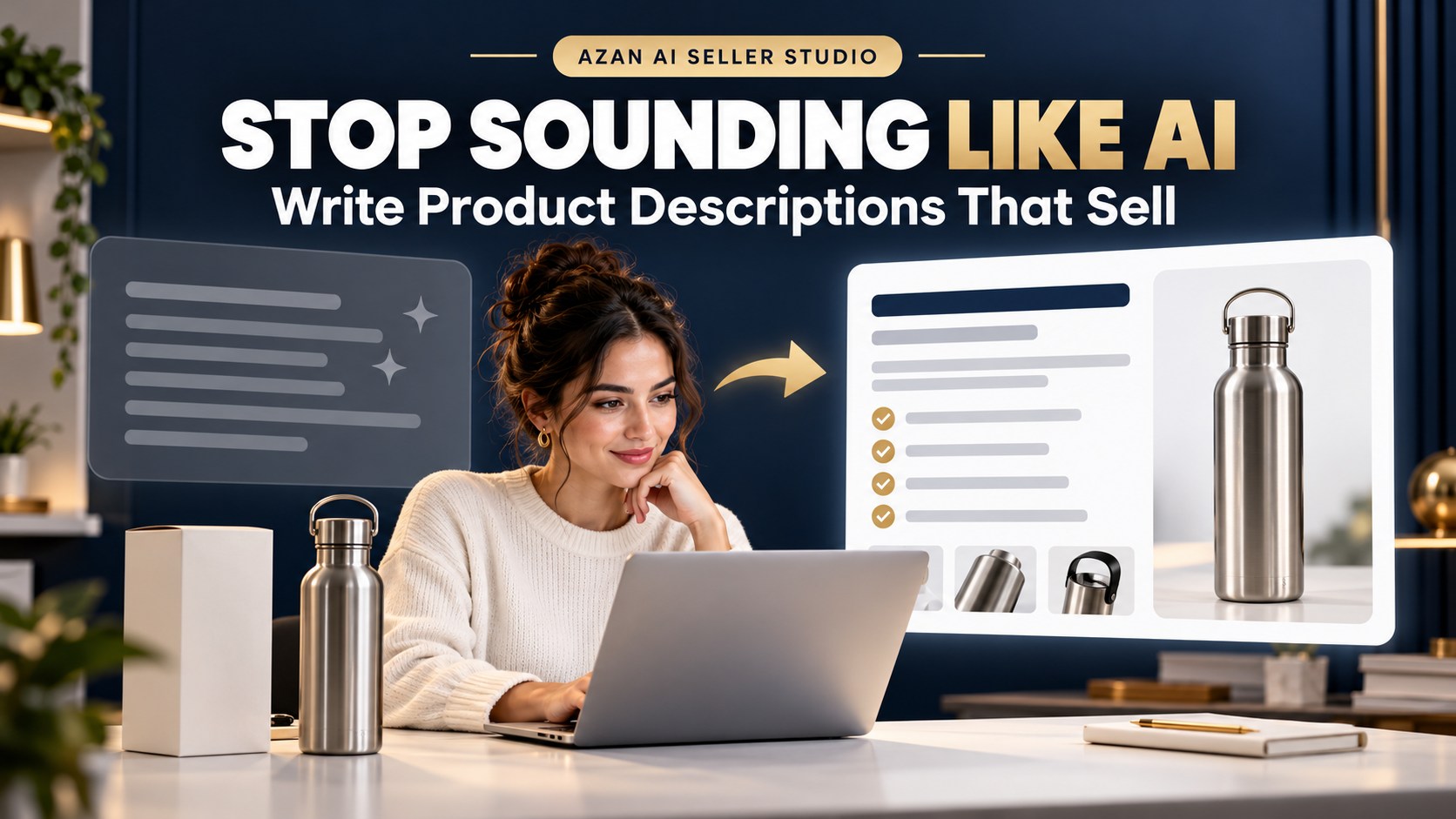
How to Write Product Descriptions That Sell Without Sounding Like AI
By Muhammad Nadeem · Blog #32
📖 11 min read · 2,364 words
# How to Write Product Descriptions That Sell Without Sounding Like AI
Bilal had a useful product, competitive pricing and professional photographs.
Yet the description on his online store sounded like this:
“Experience the ultimate innovation designed to revolutionize your lifestyle with unmatched quality and exceptional performance.”
It sounded impressive—until he read it again.
What exactly was the product made from? Who was it designed for? What problem did it solve? What was included in the package?
The description answered none of those questions.
Bilal had used AI to make his original supplier copy sound more professional. Instead, it replaced useful facts with vague promotional language.
The problem was not that he used AI.
The problem was that he asked AI to write before giving it enough verified information.
Bilal is a fictional character representing a common challenge faced by online sellers.
What Makes a Product Description Effective?
A product description has three important jobs:
- Help shoppers understand the product
- Explain why its features matter
- Reduce uncertainty before purchase
Good copy does not need to sound dramatic. It needs to make the buying decision easier.
Compare these two examples:
Weak description
Upgrade your everyday routine with this premium, game-changing bottle. Its revolutionary design delivers an unmatched hydration experience wherever life takes you.
Clearer description
This 750 ml stainless-steel bottle features double-wall insulation and a leak-resistant screw lid. Its slim shape fits most standard cup holders, making it suitable for commuting, office use and everyday travel.
The first version contains stronger adjectives.
The second version contains stronger information.
💡 Practical rule: If a sentence sounds impressive but tells the buyer nothing specific, rewrite it.
Why AI-Written Product Descriptions Often Sound Robotic
AI usually becomes repetitive or generic when the input is incomplete.
If you provide only:
“Write a description for a water bottle.”
the result has to fill in the missing context. It may use familiar phrases such as:
- Elevate your lifestyle
- Game-changing solution
- Must-have accessory
- Unmatched convenience
- Perfect for everyone
- Revolutionary design
- Premium quality
- Take it to the next level
These phrases are not always grammatically wrong. The problem is that almost any seller could use them for almost any product.
The description begins to sound artificial because it lacks evidence, personality and product-specific detail.
Start With a Verified Product Brief
Before generating or rewriting a listing, collect the facts that affect the purchase.
Use this product brief:
| Information | Example |
|---|---|
| Product | Insulated water bottle |
| Capacity | 750 ml |
| Material | Stainless steel |
| Color | Navy blue |
| Lid | Screw lid with silicone seal |
| Main feature | Double-wall insulation |
| Dimensions | Add verified measurements |
| Package contents | One bottle and one cleaning brush |
| Target customer | Commuters, students and office workers |
| Main use | Everyday drinks and travel |
| Care instructions | Hand wash recommended |
| Limitation | Not designed for carbonated drinks |
| Marketplace | Amazon, Noon or Shopify |
| Tone | Clear and practical |
Do not leave important details for AI to guess.
If you do not know whether a product is dishwasher-safe, leakproof, BPA-free, food-grade or covered by a warranty, do not include the claim until it has been verified.
Turn Features Into Buyer Benefits
A feature describes the product.
A benefit explains why that feature matters.
| Feature | Buyer-focused benefit |
|---|---|
| 750 ml capacity | Carries enough water for commuting, work or study |
| Double-wall insulation | Helps maintain the drink’s temperature |
| Slim shape | Fits more easily into bags and standard cup holders |
| Silicone lid seal | Helps reduce accidental leakage when properly closed |
| Wide opening | Makes filling and cleaning more convenient |
| Stainless-steel body | Provides a durable surface for everyday use |
Benefits should come from real features—not imagination.
For example, if the manufacturer only says “double-wall insulation,” avoid promising that a drink will remain cold for 24 hours unless that duration has been tested and documented.
A safer sentence would be:
Double-wall insulation helps maintain the temperature of hot or cold drinks during everyday use.
Bilal’s Product-Description Workflow
Bilal stopped asking AI to “make the description amazing.”
Instead, he followed a more controlled process.
Step 1: Collect the source information
He gathered:
- Supplier specifications
- Product packaging
- Verified dimensions
- Material information
- Package contents
- Care instructions
- Product photographs
- Customer questions
- Marketplace requirements
He separated confirmed facts from assumptions.
Step 2: Identify the intended buyer
A description written for a parent may focus on easy cleaning and daily practicality.
A description for an office worker may focus on portability, appearance and desk use.
A description for an outdoor customer may focus on durability, capacity and carrying convenience.
The same product can serve several audiences, but the listing should have a clear primary buyer.
Step 3: Choose the destination
Amazon, Noon, Shopify, Etsy and eBay do not present product information in exactly the same way.
A marketplace listing may require:
- A searchable title
- Scannable feature bullets
- Structured product attributes
- A compact description
- Search terms or tags
A Shopify product page may allow:
- A stronger brand introduction
- More detailed explanations
- Lifestyle sections
- Comparison tables
- FAQs
- Care and delivery information
Use the same verified facts, but adapt the structure to the destination.
Step 4: Generate a structured first draft
Bilal entered his verified details into the Azan AI Listing Studio.
Instead of asking for one long paragraph, he generated organized listing sections, including:
- SEO title
- Product description
- Feature bullets
- Meta description
- Keyword ideas
- Social copy
This gave him a working draft—not an automatic final answer.
Step 5: Remove generic language
He searched the draft for phrases that could apply to almost any competing product.
He removed or replaced wording such as:
- Ultimate solution
- Unparalleled quality
- Revolutionary
- Transform your life
- Perfect for everyone
- Best on the market
- Guaranteed results
Every replacement added a fact, use case or meaningful benefit.
Step 6: Review every claim
Bilal compared the draft against:
- The product itself
- Supplier documents
- Labels and packaging
- Verified measurements
- Included accessories
- Marketplace policies
Only then was the listing ready to publish.
A Simple Product-Description Structure
Use this framework when building a new description.
1. Start with the product and its main purpose
Tell the shopper what the item is and where it fits into everyday life.
Designed for commuting, work and daily travel, this 750 ml insulated bottle provides a practical way to carry hot or cold drinks.
2. Explain the most important features
Connect each feature to a real use.
Its double-wall stainless-steel construction helps maintain drink temperature, while the slim body fits comfortably into many bags and standard cup holders.
3. Add practical details
Answer questions that could delay the purchase.
The screw lid includes a silicone seal and should be closed firmly before carrying. A wide opening makes the bottle easier to fill and hand-wash.
4. State what is included
The package contains one 750 ml bottle and one cleaning brush.
5. Add limitations or care information
Hand washing is recommended. Do not use with carbonated drinks unless the manufacturer confirms compatibility.
A useful limitation can increase trust because it helps the customer use the product correctly.
Before-and-After Product Description
Original supplier copy
High-quality vacuum cup. Fashion design. Keeps water hot and cold. Easy carrying. Best gift for everyone.
Weak AI rewrite
Discover the ultimate hydration companion, expertly designed to elevate every adventure. With premium construction and exceptional temperature control, this stylish bottle is the perfect choice for everyone.
Improved version
Carry hot or cold drinks in this 750 ml double-wall stainless-steel bottle. Its slim profile is suitable for commuting, office desks and everyday travel, while the screw lid and silicone seal help reduce leakage when properly secured. The wide opening makes the bottle easier to fill and clean. The package includes one bottle and one cleaning brush.
The improved description is not louder.
It is more useful.
How to Refresh an Existing Product Description
You do not always need to build a listing from the beginning.
An older description may already contain the correct information but suffer from:
- Long, difficult paragraphs
- Repeated features
- Weak organization
- Supplier-style grammar
- Keyword stuffing
- Missing benefits
- Inconsistent tone
- Outdated positioning
In that case, use the Azan AI Marketplace Description Rewriter.
Add the original description, verified product details, target marketplace, required keywords and preferred tone.
The objective is to improve the presentation while preserving the truth.
After generating the new version, compare it line by line with the source information.
Write for Shoppers and Search Engines
SEO matters, but keywords should help describe the product—not interrupt the reading experience.
Suppose the primary phrase is:
insulated stainless-steel water bottle
Related phrases might include:
- 750 ml water bottle
- reusable drink bottle
- insulated bottle for work
- travel water bottle
- stainless-steel bottle with lid
A natural sentence could be:
This 750 ml insulated stainless-steel water bottle is designed for commuting, office use and everyday travel.
A stuffed version would be:
Buy the best insulated stainless-steel water bottle, 750 ml water bottle, travel water bottle and reusable drink bottle for work.
The second version feels unnatural and reduces trust.
Practical keyword placement
| Listing area | Recommended use |
|---|---|
| Title | Primary product phrase and key deciding attributes |
| Bullets | Features, benefits, materials and use cases |
| Description | Supporting phrases used naturally |
| Structured fields | Accurate material, size, color and compatibility details |
| Search fields or tags | Relevant terms permitted by the platform |
| Meta description | Clear summary designed to earn the click |
Do not repeat the same phrase in every sentence.
Make the Description Easy to Scan
Many shoppers will not read every word.
Help them find the important information quickly.
Use:
- Short paragraphs
- Clear headings
- Feature bullets
- Specific measurements
- Package-content details
- Care instructions
- Compatibility information
- Simple language
Avoid:
- One large block of text
- Excessive capital letters
- Repeated exclamation marks
- Long introductions
- Unsupported comparisons
- Too many emojis in marketplace listings
- Technical terminology without explanation
A shopper should be able to understand the product even after scanning only the title, bullets and first paragraph.
Claims That Require Extra Care
Some product categories carry higher legal, safety or platform-policy risks.
Review descriptions carefully when selling:
- Health products
- Supplements
- Cosmetics
- Children’s products
- Electrical products
- Safety equipment
- Food-contact products
- Medical devices
- Branded goods
- Regulated or certified products
Do not invent or casually rewrite claims such as:
- Clinically proven
- Doctor recommended
- Non-toxic
- Hypoallergenic
- Organic
- Medical grade
- Certified
- Eco-friendly
- Fireproof
- Waterproof
- Guaranteed
- Authentic
Only publish such claims when you have appropriate evidence and the wording complies with the destination marketplace and applicable laws.
AI can organize supplied information. It cannot create valid evidence for a claim.
The Human Review Checklist
Before publishing an AI-assisted product description, check:
- [ ] The product name is correct
- [ ] The brand and model are accurate
- [ ] Materials match the packaging or supplier documentation
- [ ] Measurements and quantities are correct
- [ ] Colors and variations are not mixed
- [ ] Package contents are clearly stated
- [ ] Compatibility information is accurate
- [ ] No accessories have been invented
- [ ] No unsupported certification appears
- [ ] No guarantee has been added without authorization
- [ ] Keywords read naturally
- [ ] The description suits the intended marketplace
- [ ] The tone matches the brand
- [ ] Important limitations are included
- [ ] The final copy has been proofread
🟡 Keep the original product brief. It gives you a reliable reference when updating the listing or answering customer questions later.
Frequently Asked Questions
Can AI write a complete product listing?
Yes. An AI listing tool can generate a structured first draft containing a title, bullets, description, keywords and related copy. The seller should verify every product fact and adapt the result to current marketplace requirements before publishing.
How do I make an AI product description sound human?
Provide specific product facts, identify the intended buyer, choose a clear tone and remove generic promotional phrases. Read the final version aloud. If a sentence could describe hundreds of unrelated products, make it more specific.
Should product descriptions include keywords?
Yes, but keywords should appear naturally. Use the primary phrase in an important location and distribute closely related terms only where they help explain the product.
Can I use the same description on Amazon, Noon and Shopify?
The verified product facts can remain consistent, but the structure, formatting, tone and keyword placement should be adapted for each channel.
What information should I give an AI listing generator?
Provide the product name, category, verified features, materials, dimensions, color, package contents, audience, use cases, marketplace and preferred tone. Include required phrases or restrictions where relevant.
Can AI invent missing product specifications?
It may generate plausible-sounding details when the input is incomplete. Never treat an AI-generated specification as verified product information. Confirm missing details independently or leave them out.
What is the difference between a listing generator and a description rewriter?
A listing generator builds structured copy from product details and notes. A description rewriter improves an existing supplier description, old listing or rough draft while retaining the verified facts.
Will a better product description guarantee sales?
No. Sales may also depend on demand, pricing, photographs, reviews, delivery, advertising, competition and customer trust. Clearer copy helps remove confusion, but it cannot guarantee performance.
The Lesson From Bilal’s Listing
Bilal did not stop using AI.
He changed the way he used it.
Instead of asking AI to make the product sound impressive, he supplied verified facts and asked it to make those facts clear.
His final workflow became:
Verify → Structure → Generate → Edit → Check → Publish
That order matters.
AI can help sellers move faster, organize information and create more consistent listings. The seller must still protect the accuracy, usefulness and credibility of the final page.
A good product description does not need to shout.
It needs to answer the buyer’s questions.
Create Your Product Listing with Azan AI →
Azan AI community
Join the Conversation
Was this guide useful?
Comments
Have a question or an idea to add? Share it with the Azan AI community.
Loading comments…
Reference: Blog #32 — quote this number if you contact us about this article